Soccer is the most widely followed sport in the world, and it is also one of the most complex to bet on. A match can end in a draw, goals are scarce, and many markets settle on the score after 90 minutes rather than on who eventually advances. Before placing any wager, it pays to understand how odds are displayed, what each market actually covers, and how a sportsbook decides whether a bet has won, lost, or been refunded.
This guide explains soccer betting from the ground up: odds formats and implied probability, the bookmaker’s margin, the most common pre-match and live markets, Asian handicaps, futures, tournament versus league dynamics, the research factors that matter, and how to manage a budget responsibly. It is written for information only. Betting always carries a risk of losing money, and no strategy or statistic can guarantee a result.
What Is Soccer Betting?
Soccer betting means placing a wager on the outcome of a match, an event within a match, or a competition as a whole. Bets range from the simplest question — who wins? — to highly specific ones, such as the number of corners in the first half or whether a particular player scores.
Soccer differs from sports such as basketball or American football in three important ways. If you already know how betting works in a sport where every game produces a winner, our NBA betting guide is a useful point of comparison:
- A draw is a normal result. Most soccer markets price three outcomes, not two.
- Goals are scarce. Typical totals lines sit around 2.5 goals, so a single goal can change the outcome of several markets at once.
- Regulation time usually decides settlement. Most match markets are settled on the score after 90 minutes plus stoppage time, even in knockout matches that continue into extra time and penalties.
Pre-Match and Live Betting
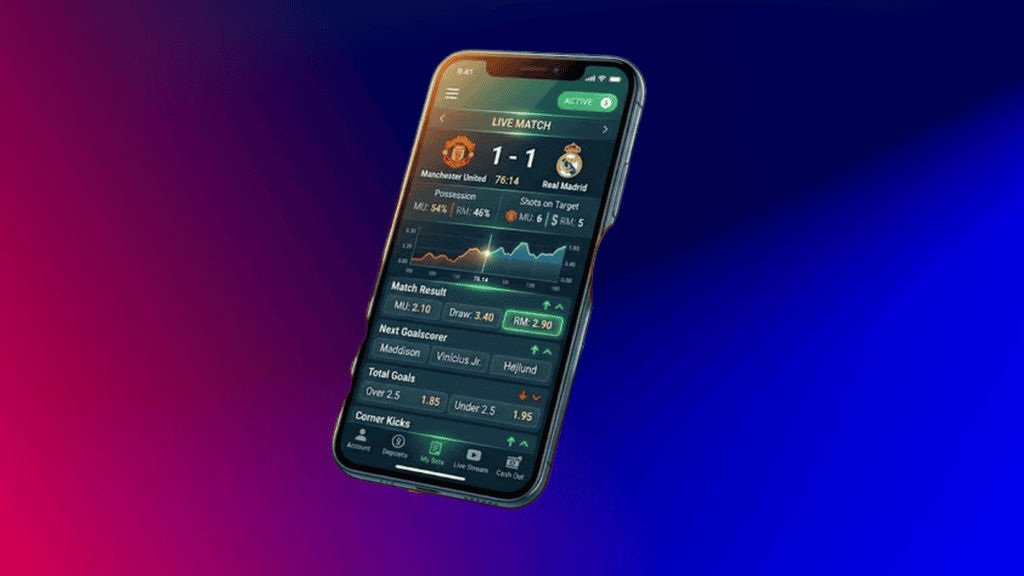
Soccer bets fall into two broad groups:
- Pre-match bets are placed before kickoff. Odds are set in advance and adjusted as team news and betting activity come in.
- Live (in-play) bets are placed after kickoff. Odds change continuously as the score, the clock, red cards, and substitutions alter the likely outcome.
How a Soccer Bet Works
Every bet follows the same basic life cycle:
- The market is published. A sportsbook lists a match and the outcomes available, such as home win, draw, or away win.
- Odds are set. Prices reflect statistical models, team information, the book’s margin, and the money being wagered.
- The bet is accepted. The selection, stake, odds, and time of placement are recorded. Your bet is locked at the odds shown when it is confirmed.
- The match is tracked. Goals, cards, and other events are recorded, and live markets may be suspended when key incidents occur.
- The bet is settled. Once the result is official, the bet is graded as won, lost, or void according to the market’s rules.
Simple example: you stake $10 on the home team at decimal odds of 2.50. If the home team wins, you receive $25 in total — your $10 stake plus $15 profit. If the match is drawn or the away team wins, the $10 stake is lost.
How to Read Soccer Odds
Odds tell you two things: how likely the market considers an outcome to be, and how much a winning bet pays. Soccer’s global audience means you may see odds in three different formats.
American (Moneyline) Odds
American odds are built around a $100 base:
- A minus sign (−) shows how much you must stake to win $100 in profit. At −150, a $150 stake returns $100 profit ($250 in total).
- A plus sign (+) shows how much profit a $100 stake returns. At +130, a $100 stake returns $130 profit ($230 in total).
The minus sign marks the favorite; the plus sign marks the underdog.
Decimal Odds
Decimal odds show the total return per 1 unit staked, including the stake. At 1.67, a $100 bet returns $167 in total, which is $67 profit. At 2.30, a $100 bet returns $230. Decimal odds are the easiest format for comparing prices quickly.
Fractional Odds
Fractional odds, traditional in the UK and Ireland, show profit relative to the stake. At 13/10, every $10 staked returns $13 profit. At 4/6, every $6 staked returns $4 profit. Your stake is returned on top of the profit.
Odds Format Comparison
| Odds Format | Favorite Example | Underdog Example | What It Shows | Total Return on $100 (Favorite / Underdog) |
|---|---|---|---|---|
| American | −150 | +130 | Stake needed to win $100 / profit on $100 | $166.67 / $230 |
| Decimal | 1.67 | 2.30 | Total return per unit staked | $167 / $230 |
| Fractional | 4/6 | 13/10 | Profit relative to stake | $166.67 / $230 |
Small differences come from rounding when odds are converted between formats.
How to Convert Between Formats
| From | To Decimal | Example |
|---|---|---|
| American positive (+) | (odds ÷ 100) + 1 | +130 → 2.30 |
| American negative (−) | (100 ÷ |odds|) + 1 | −150 → 1.67 |
| Fractional | (numerator ÷ denominator) + 1 | 13/10 → 2.30 |
Converting everything to one format is useful when you compare prices for the same outcome across markets. Rather than doing the math by hand, you can use a betting odds calculator to convert between American, decimal, and fractional odds and see the potential return on any stake.
Implied Probability
Every price can be turned into the probability the odds imply:
- Decimal odds: 1 ÷ decimal odds. At 2.50, the implied probability is 40%.
- Negative American odds: |odds| ÷ (|odds| + 100). At −150, it is 150 ÷ 250 = 60%.
- Positive American odds: 100 ÷ (odds + 100). At +130, it is 100 ÷ 230 ≈ 43.5%.
Implied probability is the bridge between odds and your own judgment. If you believe an outcome is more likely than the price implies, the price may offer value; if you believe it is less likely, it does not.
The Bookmaker’s Margin (Vig or Overround)
Sportsbooks build a margin into their prices, so the implied probabilities of all outcomes in a market add up to more than 100%. Consider this three-way market:
| Outcome | American Odds | Decimal Odds | Implied Probability |
|---|---|---|---|
| Team A win | −110 | 1.91 | 52.4% |
| Draw | +240 | 3.40 | 29.4% |
| Team B win | +280 | 3.80 | 26.3% |
| Total | 108.1% |
The extra 8.1% is the margin. It means the odds do not reflect true probabilities and that, over time, the book expects to retain a share of all money wagered. Margins tend to be smaller on major match markets and larger on niche markets, props, and combination bets.
Settlement Rules: The 90-Minute Rule and Other Fine Print
Misunderstanding settlement rules is one of the most common reasons soccer bets lose unexpectedly. Always check the market rules before placing a wager.
What “Full Time” Means
A standard soccer match consists of two 45-minute halves plus stoppage time added by the referee. Most match markets — the three-way result, goal lines, totals, both teams to score, and correct score — settle on the result at the end of this period, often called “regular time” or “90 minutes”.
Extra Time and Penalty Shootouts
In knockout matches, a game tied after 90 minutes may go to extra time (two 15-minute periods) and then a penalty shootout. Under the 90-minute rule:
- A bet on a draw in the three-way market wins if the score is level after 90 minutes, even if one team wins in extra time.
- A bet on a team to win in the three-way market loses if the score is level after 90 minutes, even if that team later wins on penalties.
- Goals scored in extra time do not count toward standard totals, and shootout penalties never count as goals for betting purposes unless the market says so.
Markets that include extra time and penalties are labelled differently, typically “To Qualify”, “To Advance”, “To Lift the Trophy”, or “including extra time”.
| Scenario | 90-Minute Market: Team A to Win | 90-Minute Market: Draw | To Qualify: Team A |
|---|---|---|---|
| Team A wins 2–1 in regular time | Wins | Loses | Wins |
| 1–1 after 90 min, Team A wins in extra time | Loses | Wins | Wins |
| 1–1 after 90 min, Team A wins on penalties | Loses | Wins | Wins |
| 1–1 after 90 min, Team B wins on penalties | Loses | Wins | Loses |
Postponed and Abandoned Matches
If a match is postponed or abandoned, the outcome depends on the sportsbook’s published rules. Common approaches include voiding the bet and returning the stake if the match is not completed within a set period, or settling markets that were already decided at the time of abandonment (for example, an “over 0.5 goals” bet when a goal has already been scored).
Non-Standard Match Formats
Some friendlies and preseason matches are played in three or four periods of 30 minutes, or with unlimited substitutions. In such matches, standard first-half markets may not be offered, and player markets can behave differently because of heavy rotation.
Corrected Results and VAR
A goal can be awarded and then disallowed after a video review. Bets are settled on the official result, so a goal that is overturned does not count, and live markets are usually suspended during reviews.
The Main Types of Soccer Bets
Most soccer wagers fall into a handful of core market types. Understanding how each one treats the draw is central to reading soccer lines correctly.
Three-Way Moneyline (1X2)
The three-way moneyline, also called the match result or 1X2 market, is the foundational soccer bet. You choose one of three outcomes:
- 1 — home team wins
- X — draw
- 2 — away team wins
Each outcome has its own price, and the draw is a genuine result you can bet on, not a push. For example:
| Outcome | Odds | Result of a $100 Bet if Correct |
|---|---|---|
| Home win | −110 | $90.91 profit |
| Draw | +240 | $240 profit |
| Away win | +280 | $280 profit |
The market settles after 90 minutes plus stoppage time. If you back a team and the match ends level, the bet loses.
Two-Way Moneyline
A two-way moneyline offers only two outcomes. In soccer it appears in two forms: markets where a winner is guaranteed (such as “To Qualify” in a knockout tie) and draw-protected markets such as Draw No Bet. Read the market description to see how a draw after 90 minutes is treated.
Double Chance
Double chance covers two of the three outcomes with one bet:
- 1X — home win or draw
- X2 — away win or draw
- 12 — either team wins (no draw)
Because it covers more outcomes, double chance pays less than a single selection on the three-way market. It suits situations where you are confident a team will not lose but unsure whether it will win.
Draw No Bet
Draw No Bet removes the draw as a losing outcome. If your team wins, you win; if it loses, you lose; if the match is drawn after 90 minutes, your stake is refunded. Odds are lower than on the straight three-way market because one path to losing has been removed. Draw No Bet is mathematically equivalent to an Asian handicap of 0.
Comparing Draw-Protection Options
| Market | Your Team Wins | Draw | Your Team Loses | Relative Payout |
|---|---|---|---|---|
| Three-way moneyline | Win | Lose | Lose | Highest |
| Draw No Bet | Win | Stake refunded | Lose | Medium |
| Double chance (win or draw) | Win | Win | Lose | Lowest |
Goal Line and Handicap Betting
Handicap markets give one team a virtual head start or deficit in goals to balance a perceived difference in strength. The handicap is added to the actual result to settle the bet.
- Half-goal lines (−0.5, −1.5, +1.5): no push is possible. A −1.5 favorite must win by two or more goals; a +1.5 underdog covers if it wins, draws, or loses by exactly one goal.
- Whole-goal lines (−1, +1, −2): a push is possible. On −1, a one-goal win means the stake is refunded, a win by two or more wins the bet, and a draw or loss loses it.
Some markets, often called European handicap or three-way handicap, include a separate “handicap draw” outcome instead of a refund. Always check which version you are viewing.
Asian Handicap
Asian handicap betting eliminates the draw by using whole, half, and quarter-goal lines. It is popular with experienced bettors because it offers only two sides and usually carries a lower margin than the three-way market.
Quarter-goal lines (such as −0.25 or −0.75) split your stake into two equal halves placed on the two adjacent lines. For example, a $100 bet at −0.75 is effectively $50 at −0.5 and $50 at −1.
| Line (Your Team) | Win by 3+ | Win by 2 | Win by 1 | Draw | Lose |
|---|---|---|---|---|---|
| 0 (Draw No Bet) | Win | Win | Win | Refund | Lose |
| −0.25 | Win | Win | Win | Half lost, half refunded | Lose |
| −0.5 | Win | Win | Win | Lose | Lose |
| −0.75 | Win | Win | Half won, half refunded | Lose | Lose |
| −1 | Win | Win | Refund | Lose | Lose |
| −1.25 | Win | Win | Half lost, half refunded | Lose | Lose |
| −1.5 | Win | Win | Lose | Lose | Lose |
| −1.75 | Win | Half won, half refunded | Lose | Lose | Lose |
For the underdog, the same logic works in reverse. A team at +0.25 wins the bet outright with a win, wins half and gets half refunded with a draw, and loses with a defeat. A team at +0.5 covers with a win or a draw.
Totals (Over/Under Goals)
Totals bets ask whether the combined number of goals will be over or under a set line. The most common line is 2.5 goals, but lines usually range from 1.5 to 4.5 depending on the teams.
| Line | Over Wins If | Under Wins If | Push Possible? |
|---|---|---|---|
| 1.5 | 2+ goals | 0–1 goals | No |
| 2.5 | 3+ goals | 0–2 goals | No |
| 3 | 4+ goals | 0–2 goals | Yes, at exactly 3 |
| 3.5 | 4+ goals | 0–3 goals | No |
Asian totals use quarter lines too. An over 2.75 bet, for example, is half on over 2.5 and half on over 3: three goals wins half and refunds half.
It helps to read the totals and the three-way market together. A match with a heavy favorite often carries a higher total, while two evenly matched defensive teams may be priced at a lower line or with the under favored.
Team Totals
Team totals work like match totals but count only the goals of one team. A bet on the away team over 1.5 goals wins if that team scores two or more, regardless of the final result.
Both Teams to Score (BTTS)
BTTS is a yes-or-no market on whether each team scores at least once. A 2–1 result makes “Yes” the winner; a 3–0 or 0–0 result makes “No” the winner. It is easy to follow and remains live until the final whistle. BTTS is often combined with the match result or totals, such as “Home win and BTTS Yes”.
Half-Time/Full-Time
This market combines two predictions: the result at half-time and the result at full-time. There are nine possible combinations, such as Home/Home, Draw/Home, or Away/Draw. Because you must get both parts right, odds are higher than for the match result alone.
Correct Score
Correct score asks you to predict the exact final scoreline after 90 minutes. The odds are high because there are many possible outcomes. Scores such as 1–0, 1–1, and 2–1 are typically the shortest-priced options.
Goalscorer and Player Markets
Player markets focus on individual performance, including:
- Anytime goalscorer — the player scores at any point in the match
- First or last goalscorer — the player scores the first or last goal
- Shots and shots on target — over/under lines for a specific player
- Assists, tackles, saves, and cards — available on many major matches
Check the rules for non-starters, substitutes, and own goals. Many markets void bets on players who do not take the field, and own goals usually do not count toward a player’s goalscorer bet.
Corners and Cards
Corners and card markets cover the total number of corners or bookings in a match, by team, or by half. Cards are often settled in “booking points” (for example, 10 for a yellow card and 25 for a red card), so read the rules carefully. Card markets depend heavily on refereeing decisions and are considered more open to manipulation than goal markets, which is one reason some operators set lower limits on them.
Short-Window Markets
These markets focus on a narrow period of the match and settle quickly, for example:
- A goal in the first 10 minutes
- The team leading after 15 minutes
- A goal between minutes 60 and 75
They are high-variance markets: a single moment decides them.
Parlays and Same-Game Combinations
A parlay (also called an accumulator or multiple) links several selections into one bet. A same-game combination, sometimes called a bet builder, links several selections from one match, such as “Home win + over 2.5 goals + a named player to score”.
- Every leg must win for the bet to pay.
- Odds multiply across legs, increasing potential payouts.
- The margin compounds with each leg, so parlays usually carry a larger built-in edge for the book than single bets.
- Correlation matters. Selections from the same match are often linked (a favorite winning and the over hitting), and sportsbooks price same-game combinations to account for this, so the combined odds may be lower than multiplying individual prices would suggest.
Futures and Outright Betting
Futures (outrights) are bets on outcomes decided over a whole season or tournament.
Common Futures Markets
| Market | What You Bet On | Settles |
|---|---|---|
| League winner | Champion of a domestic league | End of season |
| Tournament winner | Winner of a cup or international tournament | Final |
| Top four / relegation | Final league position bands | End of season |
| Group winner / group order | Who tops a group, or the exact finishing order | End of group stage |
| To qualify from group | Whether a team advances | End of group stage |
| Top goalscorer (e.g., Golden Boot) | Leading scorer of a league or tournament | End of competition |
| Best goalkeeper / player awards | Individual awards | End of competition |
| Stage of elimination | The round in which a team goes out | When the team exits |
What to Consider With Futures
- Variance is high. Injuries, suspensions, managerial changes, and the bracket draw can change everything between placement and settlement.
- Money is tied up. Your stake is held until the market settles, sometimes for months.
- Timing involves a trade-off. Early prices are set with less information and may be looser, while later prices reflect more information but are typically sharper.
- Context matters for player markets. A striker on a team likely to go deep in a tournament has more matches in which to score than a striker on a team expected to exit early.
- Dead-heat rules apply. If two or more players tie for a top-scorer market, many books divide the stake according to the number of players tied.
Live (In-Play) Soccer Betting
Live betting lets you wager while the match is in progress. Most pre-match markets are also available live, along with markets such as “next team to score”.
How Live Odds Move
Live prices react to:
- Goals — a single goal can move a team from underdog to favorite within seconds.
- Red cards — playing with ten men changes win, total, and next-goal probabilities.
- Penalties and VAR reviews — markets are usually suspended until the decision is confirmed.
- Time remaining — as the clock runs down with the score level, the draw shortens and the over drifts.
- Tactical changes — substitutions and formation changes can shift the balance of a match.
Suspensions and Delays
Sportsbooks suspend markets during dangerous attacks, penalties, and video reviews, and many build in a short delay before accepting a live bet. A bet may be rejected or re-offered at new odds if the price changes before it is accepted.
Cash-Out
Some operators offer a cash-out feature that lets you settle a bet early for an amount based on the current state of the match. Availability varies by market and operator, and the offered amount includes a margin, so cashing out generally returns less than the bet’s statistical value.
Live Betting Cautions
Live betting is fast, emotional, and easy to overdo. Broadcast feeds are often delayed relative to the data used to price markets, so what you see on screen may already be reflected in the odds. Decide in advance how much you are prepared to spend during a match.
Tournament Betting vs League Betting
The competition format shapes the betting picture.
Group Stages
- Teams play a small number of matches, so a single result carries a lot of weight.
- In the final round of group matches, some teams may already have qualified or been eliminated, and coaches may rotate players. Be careful not to assume motivation or lineups without confirmed information.
- When both teams would advance with a draw, the match situation can influence how openly it is played, but this is never a certainty.
Knockout Rounds
- Every tie is single elimination (or a two-legged tie in some club competitions), and evenly matched teams often produce tight, low-scoring games.
- The 90-minute rule matters most here: a regulation draw is common and is a separate outcome from “to qualify”.
- In two-legged ties, the first-leg result affects how each team approaches the second leg, and away teams protecting a lead may play more defensively.
Domestic Leagues
- Long seasons provide large samples of data on form, home and away records, and scoring patterns.
- Fixture congestion from cup and continental competitions can lead to rotation.
- End-of-season matches can involve teams with little left to play for, while others fight for titles, European places, or survival.
What to Research Before Betting on Soccer
Information can help you understand a match, but no statistic, trend, or research method can predict or guarantee a result.
Key Factors to Review
- Expected goals (xG). xG estimates the quality of scoring chances from factors such as shot location and type. It often gives more context than the final score alone, but models differ by provider, and past numbers do not guarantee future performance.
- Confirmed lineups and availability. Injuries, suspensions, and rotation can change a team significantly. Distinguish between predicted and confirmed lineups, and treat unverified reports with caution.
- Schedule and travel. Rest days, long journeys, and congested fixture lists can affect intensity and squad selection.
- Home and away performance. Home advantage exists in soccer, but its size varies by league and team.
- Style of play. Possession-based sides, counter-attacking teams, and deep-defending teams create different patterns for totals and BTTS.
- Conditions. Weather, altitude, pitch quality, and heat can influence tempo and scoring.
- Competition context. League position, qualification scenarios, and the stage of a tournament all shape how a match may be approached.
- Market movement. Odds can change before kickoff as information emerges or betting activity shifts. A price move does not guarantee any particular result.
Understanding Value
A common mistake is backing the team you think will win without asking whether the price is fair. A team that genuinely wins 60% of the time is fairly priced at around −150 (decimal 1.67). If it is offered at −300 (decimal 1.33), the bet offers poor value even though the team is likely to win.
The value question is simple: is the implied probability of the price lower than your honest estimate of the true probability? An odds value calculator can help you compare the implied probability of a price with your own estimate. Keep in mind that the result is only as reliable as the estimate you enter, and the book’s margin works against you on every bet, so a genuine edge is difficult to find and maintain.
Comparing Prices
Odds for the same outcome often differ between licensed operators, especially on niche markets such as Asian handicaps, player props, and futures. Small differences in price add up over many bets. Always confirm that the market rules — such as 90-minute settlement or the treatment of non-starters — are the same before comparing.
Occasionally, prices at different operators diverge so much that backing every outcome of a market would return slightly more than the total staked. This is known as arbitrage. An arbitrage calculator shows whether a set of odds creates such a gap and how stakes would need to be split. In practice, arbitrage carries its own risks: odds can change before every bet is accepted, settlement rules may differ between operators, stake limits can apply, and some operators restrict accounts that bet this way.
How to Place a Soccer Bet: Step by Step
The process is similar at any licensed sportsbook:
- Check that betting is legal where you are. Sports betting laws and minimum ages (often 18 or 21) vary by country and region. Use only operators licensed in your jurisdiction.
- Create and verify an account. Licensed operators require identity and age verification and may require location checks.
- Set your limits first. Decide how much you can afford to lose before depositing, and consider setting deposit limits in your account.
- Choose a match and market. Open the soccer section, select the competition and match, and browse the available markets.
- Read the market rules. Confirm whether the market settles on 90 minutes, how draws and pushes are handled, and what happens if a player does not start.
- Add the selection to your bet slip. Check the selection, odds, stake, and potential return.
- Confirm and keep a record. Once confirmed, the bet is locked at the accepted odds. Keeping your own record of bets helps you track spending honestly.
Common Soccer Betting Mistakes
- Ignoring the 90-minute rule and assuming a team that wins on penalties also wins a match-result bet.
- Confusing similar markets, such as Draw No Bet, double chance, and the −0.25 Asian handicap.
- Not reading player-market rules on non-starters, substitutes, and own goals.
- Overlooking lineup news and assuming key players will start.
- Betting on narrative instead of price. Popular clubs and national teams often attract heavy public money, which can push their odds below fair value.
- Building long parlays without accounting for the compounding margin and the fact that one wrong leg loses everything.
- Chasing losses, especially during busy weekends or long tournaments with several matches a day.
- Betting impulsively in-play in response to momentum rather than a plan.
Bankroll Management and Responsible Betting
Soccer betting should be treated as entertainment with a cost, not as a way to make money. Every wager carries financial risk, regardless of how much research you have done.
Set a Budget and Unit Size
- Use only discretionary money. Never bet money needed for rent, bills, savings, or debt payments.
- Fix a budget for a period (a week, a month, or a tournament) and stop when it is used up.
- Use a consistent stake. Many people use a flat unit of a small percentage of their budget so that a losing run does not exhaust it quickly.
- Do not increase stakes in response to wins or losses.
Healthy Habits
- Avoid chasing losses. Trying to win back money with bigger or more frequent bets usually makes the losses larger.
- Take breaks. A packed fixture list does not create an obligation to bet on every match.
- Do not bet under pressure — when upset, tired, or after drinking.
- Use the tools available. Licensed operators typically offer deposit limits, time reminders, cool-off periods, and self-exclusion. Availability varies by jurisdiction.
Warning Signs
Consider stepping back or seeking help if you notice any of the following:
- Betting more than you planned or can afford
- Borrowing money or using money set aside for essentials
- Hiding betting from family or friends
- Feeling anxious, irritable, or preoccupied with betting
- Betting to escape problems or to recover losses
Where to Get Help
Free and confidential support is available in many countries. Examples include the National Council on Problem Gambling helpline in the United States (1-800-GAMBLER), GamCare in the United Kingdom, Gamblers Anonymous meetings worldwide, and online services such as Gambling Therapy. If you are elsewhere, look for a national problem-gambling helpline in your country.
Soccer Betting Glossary
| Term | Meaning |
|---|---|
| 1X2 | The three-way match result market: home win (1), draw (X), away win (2) |
| Accumulator / Parlay | A single bet combining several selections; all must win |
| Asian Handicap | A goal-based handicap with whole, half, or quarter lines that removes the draw |
| BTTS | Both Teams to Score — a yes/no bet on whether each team scores |
| Bet Builder | A combination of several selections from the same match |
| Cash-Out | An option to settle a bet early for a value based on the current match state |
| Clean Sheet | A match in which a team concedes no goals |
| Dead Heat | A tie in a market such as top scorer, usually settled by dividing the stake |
| Double Chance | A bet covering two of the three match outcomes |
| Draw No Bet | A bet refunded if the match ends in a draw |
| European Handicap | A handicap market that includes a separate “handicap draw” outcome |
| Expected Goals (xG) | A measure of the quality of scoring chances created |
| Futures / Outrights | Bets on season-long or tournament-long outcomes |
| Implied Probability | The probability expressed by a set of odds |
| In-Play / Live | Betting after a match has started |
| Margin / Vig / Overround | The bookmaker’s built-in edge in the odds |
| Push / Void | A result in which the stake is returned |
| Regular Time | 90 minutes plus stoppage time, excluding extra time and penalties |
| To Qualify / To Advance | A market that includes extra time and penalties |
| Value | A price that implies a lower probability than the true likelihood of an outcome |
Frequently Asked Questions
Why do soccer odds have three outcomes instead of two?
Because soccer matches can end in a draw after regular time, the main match market prices three separate outcomes: home win, draw, and away win. Draw-protected markets such as Draw No Bet and some Asian handicaps reduce this to two.
Does a draw count as a loss on a moneyline bet?
On the three-way moneyline, yes. A bet on either team loses if the match is drawn after 90 minutes. On Draw No Bet, the stake is refunded instead.
Do extra time and penalties count for match bets?
Usually not. Most match markets settle on the score after 90 minutes plus stoppage time. Markets labelled “To Qualify”, “To Advance”, or “including extra time” cover the full tie.
What is the difference between Asian handicap and a regular goal line?
Both apply a goal handicap. Asian handicap uses whole, half, and quarter lines and has only two possible sides, with refunds or half-results on some lines. A three-way (European) handicap includes a separate handicap-draw outcome.
What does over 2.5 goals mean?
It means the match must contain three or more goals for the over to win. Under 2.5 wins with two goals or fewer. Because the line ends in .5, there is no push.
What is the simplest type of soccer bet for a beginner?
No bet is safe, but a single bet on the match result or on goal totals is the most straightforward because it involves one outcome and no combined legs. Parlays, correct score, and player props carry more risk and more complex rules.
How do sportsbooks make money on soccer betting?
They build a margin into the odds, so the implied probabilities of all outcomes in a market add up to more than 100%. Over many bets, this margin gives the operator an expected profit.
What happens to my bet if a match is postponed or abandoned?
It depends on the operator’s published rules. Bets are often voided if the match is not played or completed within a set period, while markets already decided at the time of abandonment may still be settled.
Is it legal to bet on soccer?
It depends on where you live. Sports betting is regulated differently across countries and regions, and minimum ages vary. Check local laws and use only licensed operators.
Final Thoughts
Soccer offers a wider range of betting markets than almost any other sport, but that variety comes with complexity. Understanding odds formats and implied probability, knowing how each market treats the draw, and reading the settlement rules — especially the 90-minute rule — will help you avoid the most common mistakes. Treat any betting as paid entertainment, keep within limits you have set in advance, and step away whenever it stops being fun.